Reputation management for restaurants
Reputation management for restaurants is shaped by three things other businesses do not face. Reviews arrive continuously rather than occasionally, so the rating is always moving and the most recent shift is the most visible. Delivery platforms rate an experience the kitchen only partly performed. And Yelp filters reviews rather than removing them, which means the usual playbook of requesting reviews works on Google and backfires there. Photographs, most of them taken by customers, carry more of the decision than any written reply, and they are the surface an operator can most directly change.
Where diners decide: Google, Yelp and TripAdvisor
A restaurant is judged in a sequence that takes about ninety seconds on a phone.
| Surface | What the diner takes from it | Speed of impact |
|---|---|---|
| Google Business Profile | Star rating, recent reviews, photos, hours | Immediate, and it is the default |
| Yelp | Longer written reviews, photos | Strong in some markets, weak in others |
| TripAdvisor | Ranking against nearby restaurants, visitor reviews | Matters most where visitors decide |
| Instagram and short video | What the food looks like now | Fast, and increasingly the discovery layer |
| Booking platforms | Availability plus a rating attached to the reservation | At the moment of commitment |
| Delivery apps | A separate rating for a different experience | Only for the delivery business |
Two things separate this from other local businesses. Photographs carry more of the decision than words, and most of them were taken by customers. And the review flow is continuous rather than occasional, which means the rating is always moving and always recent.
Yelp's system is a filter, not a removal desk
Restaurant operators lose more time to this misunderstanding than to any other.
Yelp runs automated recommendation software that decides which reviews are displayed and counted toward the rating. Reviews it does not recommend are moved to a separate page rather than deleted, and they stop affecting the star rating while remaining publicly visible to anyone who looks for them. That is a filtering decision made by software about signal quality, not a judgment about whether a review is fair, and it can move reviews in either direction over time.
What follows from that. A review does not come down because it is negative. Asking customers for Yelp reviews violates the platform's own guidelines and tends to get those reviews filtered, so the review-request campaigns that work on Google are counterproductive there. And a sudden burst of activity, positive or negative, can attract a consumer alert on the listing, which is worse than the reviews it was meant to address.
Delivery platform reviews rate what the kitchen did not do
A restaurant running delivery is rated on an experience it only partly performs. The courier was late, the bag sat on a counter, the drink leaked, an item was missed by a packer, the food travelled twenty minutes and arrived at the temperature that implies.
The operational responses are unglamorous and they work better than any reply. Packaging that survives the trip. A pared-back delivery menu that excludes dishes which do not travel. A checklist at the pass for third-party orders. Fast, unargued refunds on a missing item, because a refunded customer rarely writes the one-star and an argued one always does.
The rating on those platforms also affects placement within the app, which is a commercial consequence separate from reputation, and it is worth tracking as its own number rather than folding it into the Google average.
Photo management is the lever you actually control
The image on a restaurant's Google profile is frequently a dark, badly framed photograph taken by a customer, and it is the first thing every prospective diner sees.
Operators can upload their own, and should, in volume: the room in the light it actually has in the evening, plated dishes shot straight down, the exterior so people can find the door, the menu as an image. Owner photographs do not automatically displace popular customer photographs, but a steady supply of good ones changes the overall impression and gives the profile something current.
The other half is prompting good customer photographs, which happens through the food and the room rather than through a request. A dish that photographs well is a marketing asset with a compounding return, and this is the one area where reputation work and the actual product are the same activity.
Service recovery beats reply writing
A reply to a negative review is written for the next reader, not for the reviewer, and understanding that settles most of the arguments in a management meeting. The reviewer is rarely persuaded. The next hundred people who read the exchange are forming a view about how the restaurant behaves when something goes wrong.
Which means the useful reply is short, specific, unguarded and free of the phrase we strive. Name the thing, say what changed, offer a direct route, stop. Arguing about whether the wait was really forty minutes is the single most damaging thing an operator can publish.
Recovery in the room is better still and it is cheaper. A manager who notices the table before the meal ends prevents a review that would otherwise sit on the profile for years. That is not a reputation programme, it is floor management, and it is the highest-return reputation work a restaurant does.
The one thing to avoid entirely is manufacturing reviews. The FTC's announcement of the final rule banning fake reviews covers fabricated reviews, reviews from insiders without disclosure, and buying ratings, and it applies to a single restaurant as much as to a chain.
The one bad shift
Restaurants have a failure mode that most businesses do not: a single evening produces a cluster of bad reviews at once. A no-show in the kitchen, a POS failure during a rush, a delivery that did not arrive, and forty covers all have the same experience within three hours.
The rating moves fast because recent reviews carry visible weight in what a diner reads first, and the cluster looks like a pattern rather than an incident. Three responses actually help. Reply to a couple of them, generally and without excuses. Keep the request process running so the following week's volume dilutes the cluster. And report only the ones that break the rules, because that is the sole category with a route.
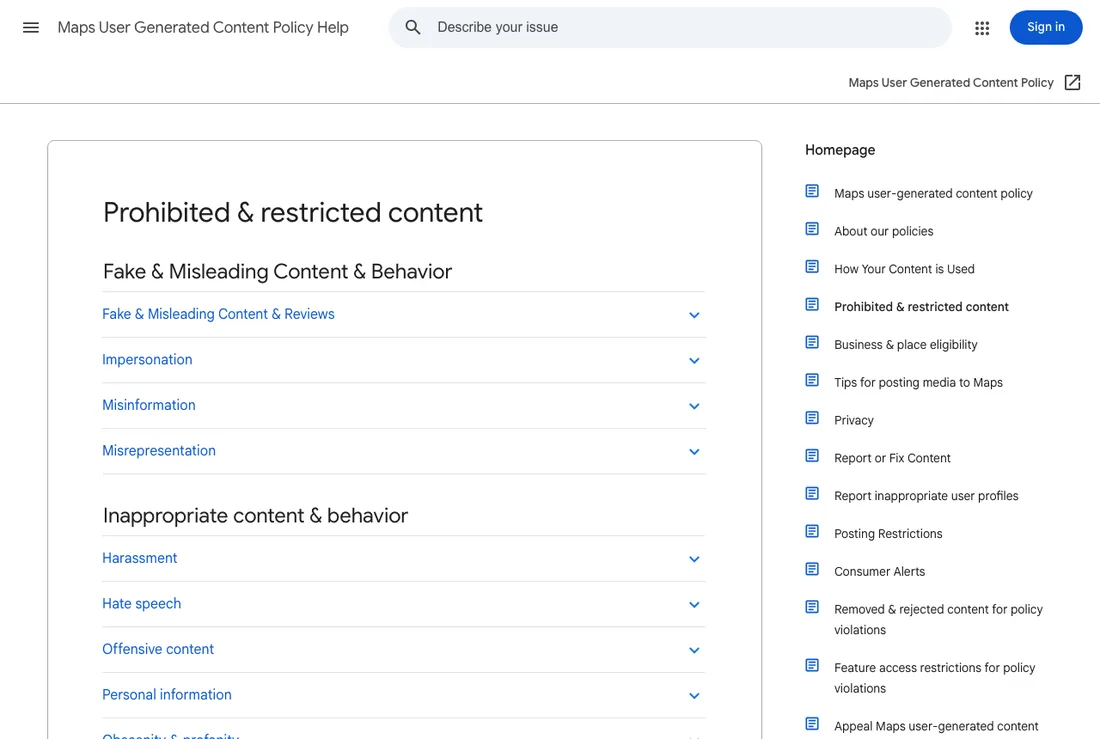
The policies Google applies when deciding whether a review comes down. The categories are things like spam, off-topic content, conflicts of interest and harassment. Being negative or being unfair is not among them. Screenshot taken 19 August 2026.
Google's prohibited and restricted content policies for reviews define what qualifies. Reviews from people who were never customers, content aimed at a person rather than the business, and posts left by a competitor are genuine candidates. A truthful account of a bad night is not, and the volume you build in the following month does more for the rating than any of it. Sorting the reportable from the permanent is the first thing a reputation audit establishes.
Questions about reputation management for restaurants
How do restaurants handle bad reviews?
Reply once, briefly, for the benefit of the next reader rather than the reviewer, fix the operational cause, keep review volume flowing so a bad night is diluted, and report only the reviews that break the platform's published rules.
Does Yelp remove reviews?
Rarely in the way operators expect. Its software filters reviews it does not recommend onto a separate page where they stop counting toward the rating but remain visible. Being negative is not grounds for removal.
Should a restaurant ask customers for Yelp reviews?
No. Soliciting reviews is against Yelp's guidelines and solicited reviews tend to be filtered out anyway. Requesting reviews on Google is permitted, as long as the request goes to everyone rather than to selected customers.
Why are delivery ratings lower than in-house reviews?
Because they measure a different experience: courier timing, temperature on arrival, and packing accuracy. Packaging, a shorter delivery menu and fast unargued refunds move that number more than replies do.