Does AI make negative content permanent?
Not in the way the phrase suggests. A model does not keep a permanent copy of a page about you, and correcting a source usually does change what an assistant says, because most consumer assistants read the live web while they answer. What genuinely persists is narrower: a claim absorbed during training can keep surfacing after the page behind it is gone, and there is no request form that edits a model's memory. This page separates the layers that move from the layers that do not, and explains why acting earlier is simply easier than acting later.
What changes and what does not
The word permanence gets used loosely here, usually to sell urgency. It is more useful to look at the layers separately, because they behave differently and they respond to different work.
| Layer | How long it holds | What reaches it |
|---|---|---|
| Live retrieval of the web | As long as the page is up and findable | Correcting, removing, or outranking the page |
| A cached or repeated answer | Until the system fetches again | Time, plus a corrected source to fetch |
| Copies on aggregators and archives | Indefinitely, unless removed at each one | A separate request to each host |
| A model's pretrained weights | Until that model is retired or retrained | Nothing directly; only new publishing over time |
Three of those four are ordinary reputation work. Only the last one is genuinely out of reach, and it is also the one people mean when they say the internet never forgets.
Training snapshots are frozen, not corrected
A model is not updated when the world is. It is replaced. When a newer version is trained on newer text, claims that were true of the old snapshot may or may not survive into the new one, and neither you nor the vendor can point at a specific sentence and remove it.
This is the honest version of the permanence problem, and it is worth stating once, plainly, rather than repeatedly. The NIST AI Risk Management Framework treats the accuracy and provenance of information in these systems as a risk to be managed rather than a solved problem, which is roughly where the field is. Nobody has a mechanism for surgical correction of a trained model, and any provider suggesting they do is describing something else.
Content licensing deals add a second path in
A growing number of publishers have signed licensing agreements that route their archives into AI systems deliberately rather than incidentally. For a person named in a news archive, the practical effect is one more path from that archive into an answer, alongside ordinary crawling.
It does not make the article more true or less removable. It does mean that if the original piece was inaccurate, the case for correcting it at the publisher, rather than only trying to suppress it in search, is stronger than it used to be. A correction on the source article travels; a suppression tactic aimed at a search results page does not.
Cached answers and repeated old claims
Between the model and the page sits a layer of caching, indexing, and reuse. A system may answer from something it fetched recently rather than fetching again. Two people asking the same question minutes apart can get different answers for this reason alone.
The useful consequence is that a first recheck after a correction proves very little. Answers move unevenly. Checking once a week for a few weeks tells you far more than checking once an hour on the day you filed.
Why speed matters more here than in search
This is the part worth being calm and specific about, because it is the one honest reason to act sooner rather than later, and it has nothing to do with alarm.
Every week a wrong page stays up is a week it can be copied, quoted, syndicated, archived, and read by a retrieval step. Fixing it early means fewer copies exist to be found later, and fewer chances for it to land in the next training snapshot. That is an argument for acting, not an argument for panicking. A wrong page corrected next month is still a wrong page corrected, and the work does not become impossible.
The limits of a noindex tag
The most common piece of advice here, blocking a page from search indexing, is real but narrower than people assume.
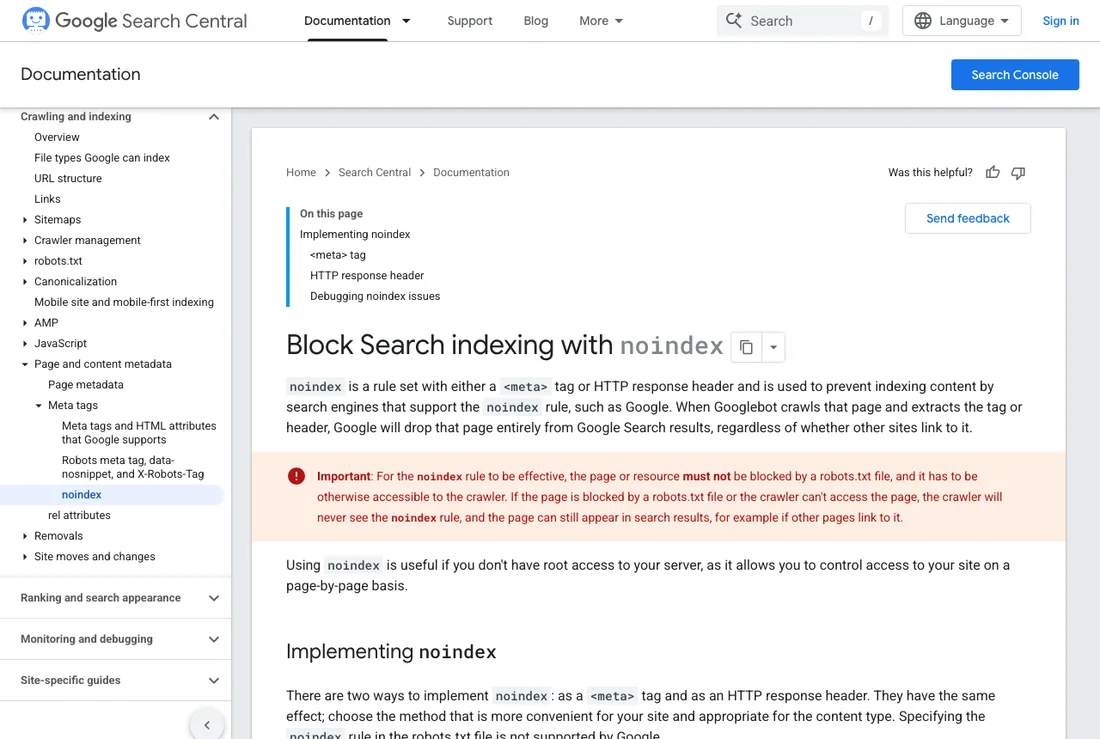
Google's own documentation for the noindex rule. It removes a page from Google Search results, which is a genuine and useful outcome. It does not delete the page, it does not reach copies on other sites, and it does not touch anything a model already learned. Screenshot taken 19 August 2026.
Read alongside Google Search Central on helpful, people-first content, the pattern is consistent: the things you control are what you publish and what you can get changed at the source. The rest is influence, not control.
What is realistic, stated once
Where a statement comes from live retrieval, correcting the source usually changes the answer, often within weeks. Where it comes from training, it can persist and nobody can put a date on when it will not. The research paper that introduced Generative Engine Optimization works on the retrieval side of that line, which is where the measurable results are, and that is not an accident.
So the plan is unglamorous and it works: correct or remove what is wrong at its source, publish accurate material that is clear enough to be read and cited, chase the copies that matter, and recheck over months rather than days. Establishing which of your problems sit on the reachable side of that line is one of the things a reputation audit is for.
Questions about ai and the permanence problem
Does AI make negative content permanent?
No. Most of what an assistant says about you comes from pages it can read right now, and correcting those pages usually changes the answer. What can persist is a claim absorbed during training, which no request form reaches.
Why does AI still repeat old information?
Usually because a copy of the original still exists somewhere findable, because the corrected page has not been recrawled or does not outrank the old one, or because the claim came from training rather than from live retrieval.
Can I ask an AI company to delete something about me?
You can use their published feedback and privacy channels, and they are worth using. What you cannot do is have a specific belief edited out of a trained model, because that is not how the training stage works.
How long before a correction shows up in AI answers?
Where retrieval is doing the work, usually weeks rather than days, and unevenly. Where training is doing the work, there is no reliable timeline, and any specific promise is invented.