
How do I request the right to be forgotten?
You request the right to be forgotten by submitting a delisting request to the search engine, naming the exact URLs, the name query they appear under, and a specific reason for each one, together with proof of identity. The right comes from European and United Kingdom data protection law, so it is available to individuals covered by that law, not to companies and not to people outside its scope. A granted request removes the search listing for name queries in the relevant region. The page itself stays online at its address, which is the single most misunderstood part of the process.
Who can request the right to be forgotten
The right belongs to individuals under European and United Kingdom data protection law. Corporations and other legal entities generally cannot use it, because data protection rules govern personal data about people. You can submit on behalf of someone else if you are legally authorised to do so, which matters for parents and for estate representatives.
If you are in the United States with no European connection, this route is not open to you. Skip to the last section, because the American options are different and they do exist.
The Google removal form, field by field
Search engines run a dedicated form for these requests. What it asks for is consistent, and vague answers are the main reason requests fail.
- Your country of residence. This determines which law is applied and which region the delisting covers.
- Your full name as it appears in the search, including any variant spellings or former names the results respond to.
- The exact URLs, one per line, copied from the address bar. Not the name of the site, not a description, not a screenshot.
- The search query each URL appears under. Usually your name, sometimes your name plus a place or an employer.
- A reason for each URL individually. A single blanket reason applied to twenty links is the weakest possible submission. Say what the page contains about you, why it is inaccurate, inadequate, irrelevant or excessive now, and what has changed since it was published.
- Identity verification. A government identification document, which can be redacted down to the name and photograph.
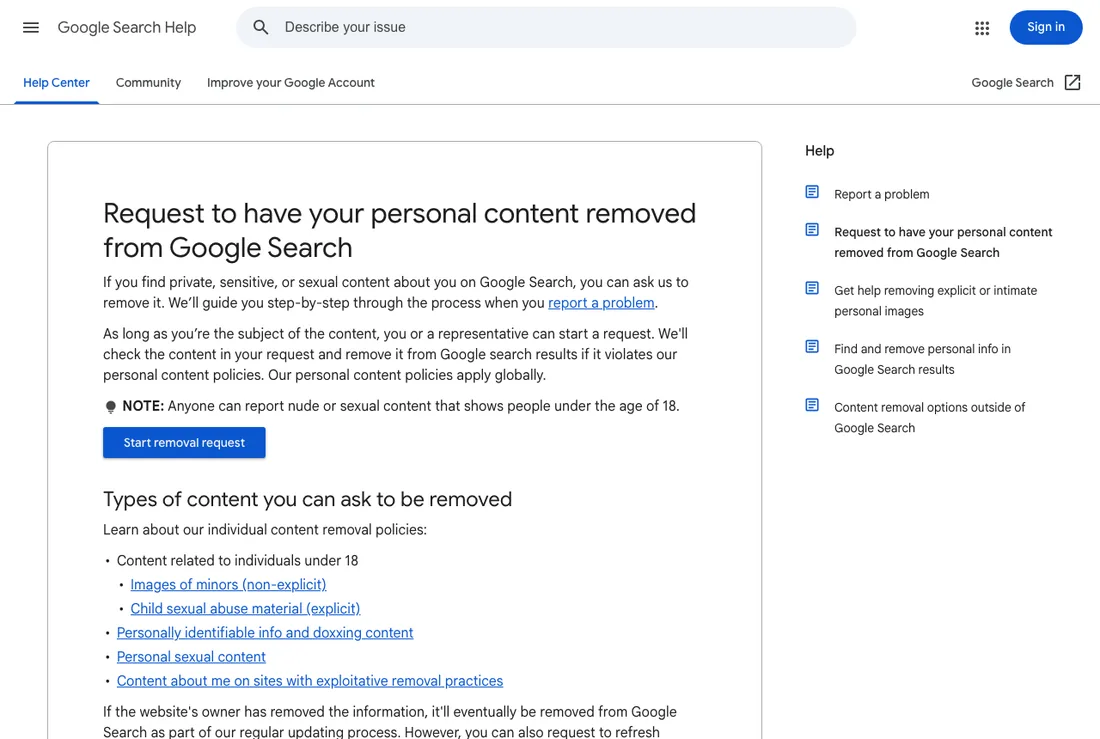
Google's own removal troubleshooter routes you by what the content is, and personal information requests, right to be forgotten requests and legal requests all take different paths from here. Starting on the wrong path is the most common way a request stalls. Screenshot taken 19 August 2026.
Evidence required, and what strengthens a request
The decision is a balance between your data protection rights and the public interest in the information staying findable. What moves that balance is specific and checkable. Include documentation that the information is out of date, such as a discharged judgment, a corrected record, or a dismissal. Include evidence that a page is factually wrong, such as a correction the publisher has already issued elsewhere. Explain your role: a private individual is treated very differently from someone holding public office or running a public company.
Search engines weigh your role in public life, where the information came from, how old it is, how sensitive the data is, whether the claims are true, and the general interest in access. Government sources and news publishers are given considerable deference, which is why requests aimed at court reporting rarely succeed.
Response times, and what one month means
Under the GDPR a controller has one month to respond to a request, extendable by two further months where the request is complex, and the request is free. In practice a simple, well-documented submission with a handful of URLs is decided faster than a sprawling one. Expect a decision per URL rather than a single yes or no across the batch.
What gets refused, and the appeal process
| Commonly granted | Commonly refused |
|---|---|
| Stale personal details with no ongoing relevance | Current professional conduct in a public role |
| Data about a private individual with no public role | Court and regulatory records still in the public interest |
| Inaccurate information the publisher has since corrected | Recent news coverage of a matter of genuine concern |
| Sensitive categories such as health, with no public interest | Requests made by a company about its own business |
| Content that plainly identifies you but serves no purpose now | Content where you are named only in passing, without personal data |
A refusal is not the end. Ask for reconsideration with new information rather than resubmitting the same request, since the second look is only useful if something has changed. If you still disagree, the next step is a complaint to your supervisory authority, which in the United Kingdom is the Information Commissioner's Office and in an EU country is that country's data protection authority.
Delisting is not deletion
Even a granted request leaves the page live. If what you want is the content gone rather than harder to find, the request has to go to whoever published it, and that is a separate conversation with a separate answer. Google's own documentation on removing information from Search is clear that search removal and page removal are different things, and it is worth reading before you decide which one you are actually asking for.
If you are in the United States
There is no equivalent right, and no form that does the same job. The tools that exist are narrower and worth knowing precisely, because most people underuse them. Google's Results About You service lets you request removal of results that expose your personal contact details such as a home address, phone number or email, and it is documented at Google's Results About You tool. Beyond that: data broker opt-outs, which several states now support through a central deletion mechanism, direct requests to publishers, and the state privacy statutes that let you ask a business to delete the data it holds about you.
The rest of the American picture, including what a state right to delete does and does not reach, is on our page about the right to be forgotten in the US, and a working explainer of the European right sits at gdpr.eu. Working out which of these routes actually applies to a specific URL is the first thing a reputation audit does.
This page is not legal advice. Article 17 of the GDPR is the primary source for the European right, and your national data protection authority is the body that can act when a request is wrongly refused.
Questions about how to request right to be forgotten
How do I request the right to be forgotten?
Submit a delisting request to the search engine with the exact URLs, the name query they appear under, an individual reason for each URL, and proof of identity. Give specific documentation rather than a general objection.
How long does the request take?
A controller has one month under the GDPR, extendable by two further months for complex requests, and the request is free. Expect a separate decision for each URL rather than one answer for the batch.
Does the right to be forgotten delete the web page?
No. It removes the search listing for name queries in the relevant region. The page stays online at its address and can still be reached directly or through other searches.
Can a business request the right to be forgotten?
Generally no. Data protection rules govern personal data about individuals, so corporations and other legal entities do not usually have delisting rights.
What happens if my request is refused?
Ask for reconsideration with new information, and if you still disagree, complain to your supervisory authority: the Information Commissioner's Office in the United Kingdom, or the relevant national data protection authority in an EU country.