
How do you spot a reputation management scam?
Judge the promise, not the pitch. The recurring red flags are a specific removal promised before the item has been examined, a large deposit requested before any scope is written down, deliverables described as activity rather than as countable items, a refusal to name anything on your list as not achievable, and any offer involving bought reviews or mass flagging. Most predatory selling here is not a fake company. It is a real one selling a claim nobody can deliver, inside a scope so loose that nothing can ever be judged unfinished. These are patterns, not firms, and this page names none.
Why reputation management scams are hard to spot
Most predatory selling in this category is not a fake company. It is a real company selling a real service with a claim attached that nobody can deliver, or a scope so vague that nothing can ever be judged unfinished. That is what makes it hard. The invoice arrives, some work happens, and a year later you cannot say whether you were served or farmed.
The patterns below are patterns, not firms. This page names no company, and it would be worth nothing if it did: this reference is published by Aurawave Inc., which also operates The Reputation.org, a firm in this same market, so a list of bad actors from us would just be competitive positioning. Tests you can run yourself are useful. Our opinion of a rival is not.
The certainty promise, first of the red flags
The single most reliable warning sign is a provider that promises a specific removal before it has examined the item. No firm decides whether a review comes down. Google decides. Yelp decides. A newspaper's editor decides. A court sometimes decides. A provider that guarantees a removal is describing a decision that belongs to somebody else.
There are cases where the odds are genuinely strong, and an experienced provider will say so in exactly those terms: this one appears to break a published rule, requests like it usually succeed, here is what happens if it does not. That sentence is what competence sounds like. Certainty is what selling sounds like.
The related version of the claim is privileged access: a hint that the firm knows people inside a platform, or has a relationship that gets things removed. Platforms process these requests through published forms and published policies, and the fundamentals of how search results are earned are documented openly in Google's own SEO starter guide. There is skill in this work, but there is no back door, and the offer of one is a story.
The upfront deposit, pressure, and the missing scope
A large payment requested before anything is written down is the pattern to watch, and the sequence matters more than the amount. Deposits are ordinary in professional services. A deposit taken before a scope exists is different, because you have traded your leverage for a description.
Related tactics run alongside it: a discount that expires today, a refusal to send anything in writing before payment, or a warning that involving a lawyer would slow things down. A firm that needs your decision faster than it can produce a scope of work is managing you, not the problem.
| The red flag | How it usually sounds | What to ask instead |
|---|---|---|
| Certainty before assessment | We can get that taken down | Which published rule does it break, and what happens if the platform says no |
| Privileged access | We have contacts there | Which public form does this request go on |
| Deposit with no scope | We need to get started today | Send me the itemised scope and I will pay against it |
| Vague deliverable | Ongoing reputation management | What will exist at the end of month one that does not exist now |
| No negatives named | Everything on your list is fixable | Which of these items would you decline to take on |
| Reporting with no data | You will get a monthly report | Show me a sample report and the raw data behind it |
| Silence on free routes | This requires our platform | Which of these could I file myself at no cost |
Bait and switch: refusing to say what is not removable
Ask any provider which items on your list they think are not achievable. The answer is the most informative thing you will hear in the whole process.
Some categories are, in the ordinary case, not removable at all. A truthful negative review that breaks no platform rule stays. Lawful reporting by a real news organisation generally stays. Court records that are public remain public, and an expungement does not reach back and clear the article that covered the arrest. A provider who agrees that every item on your list is fixable has either not looked, or is planning to bill for the attempt.
Legal claim inflation belongs in the same family. Telling a client that a platform can be sued into deleting a user's post is a claim that runs directly into Section 230, which treats the service as not being the publisher of what its users post. The Electronic Frontier Foundation's analysis of Section 230 sets out how far that protection reaches. There are real legal routes, and our page on whether reputation management is legal walks through them, but a non lawyer promising litigation outcomes is selling something they cannot perform.
Fake review selling, and mass flagging
Two tactics are not merely aggressive. They create exposure for the client who paid for them.
The first is buying reviews, positive ones for you or negative ones for someone else. This has been prohibited since the FTC's Rule on the Use of Consumer Reviews and Testimonials took effect, and the Commission's staff guidance answers the obvious question directly: reputation management companies are not exempt from the rule. The detail sits on our page about the FTC review rule.
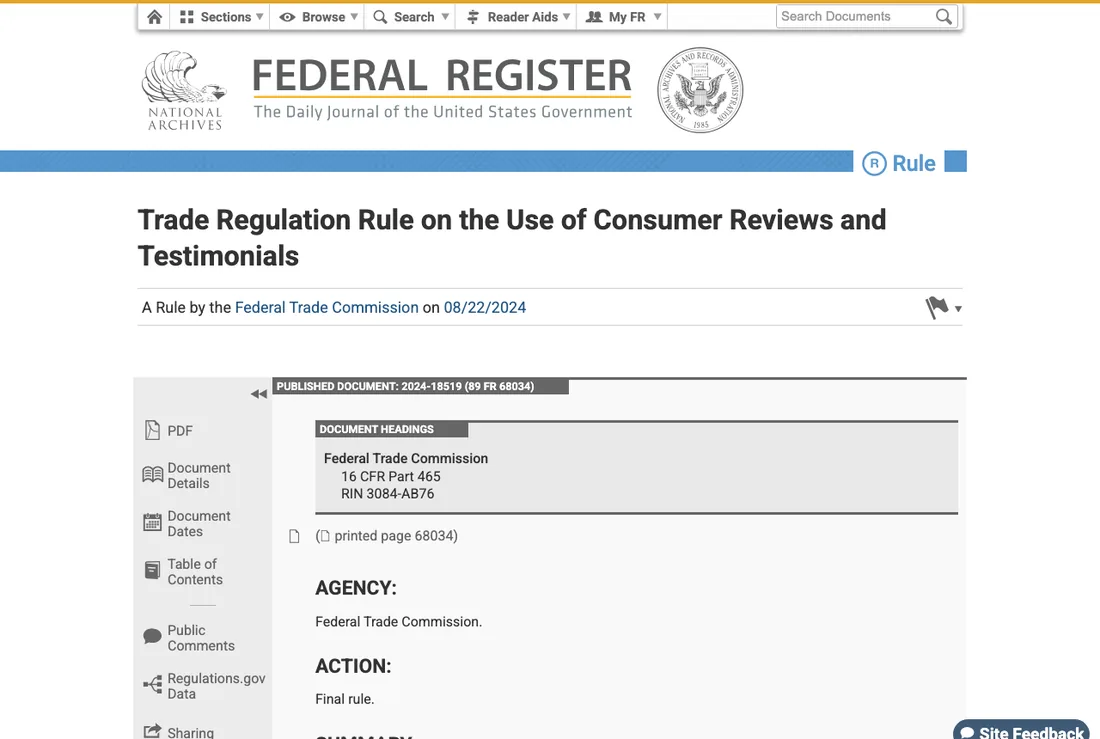
The rule as published in the Federal Register on 22 August 2024, at 16 CFR Part 465. It reaches buying reviews, selling them, insider reviews, company controlled review sites, and using groundless legal threats to suppress a negative review. Screenshot taken 19 August 2026.
The second is mass reporting, sometimes sold as flagging: filing complaints against truthful reviews or a competitor's listing in the hope volume produces a deletion. It violates most platform policies, it can get the client's own listing restricted, and it is the sort of deceptive commercial conduct addressed in the FTC's advertising and marketing guidance for businesses.
Extortion patterns, and contract terms that cost you quietly
Two adjacent business models are worth naming as patterns rather than as firms. One is the site that publishes unflattering material and then sells removal of it, which is closer to extortion than to a service. The other is an offer to attack a competitor's search results, sold as something you buy rather than something that could be bought against you.
- Automatic renewal with a short cancellation window. Long terms are not automatically wrong, but a notice period you have to diarise on the day you sign is designed to be missed.
- Content and profiles registered in the provider's name. If the pages built to displace a result are not yours, cancelling means losing them, and the problem returns.
- Deliverables described only by activity. Monitoring, optimisation and management are activities. Countable items are deliverables.
- A clause restricting what you may say publicly. A firm that contractually limits your ability to leave an honest review of it is telling you something about its other clients.
If you have already paid
Nothing here is legal advice, and none of this is a reason for embarrassment. This category is hard to evaluate from the outside, and being sold badly in it is not a judgement about you.
Practically: gather the contract, the invoices and every message, then write down what was delivered against what was described, and ask for the raw data behind any report. Payment providers have dispute processes with their own deadlines, and the FTC takes complaints about deceptive business practices. Then rebuild your own inventory from scratch so you know where you actually stand, which is what a reputation audit is for. Knowing which of your items are genuinely addressable is the thing that makes the next conversation with any provider a fair one.
Questions about reputation management red flags and scams
How do I know if a reputation management company is a scam?
Test the promise rather than the presentation. Ask which published rule the content breaks, which of your items they would decline to take on, which requests you could file yourself for free, and what will exist at the end of month one. A provider who cannot answer those without a sales call is selling certainty rather than work.
What are the red flags?
A specific removal promised before assessment, claimed contacts inside a platform, a large deposit taken before a written scope, deliverables described only as ongoing management, reports with no underlying data, silence about the free routes, and any offer to buy reviews or mass report a competitor.
Is it a bad sign if a company will not promise removal?
No, it is usually the opposite. Platforms and publishers decide removals, not providers. A firm that says this one appears to break a published rule, requests like it usually succeed, and here is what happens if it does not, is describing the work accurately.
Is buying positive reviews illegal?
The FTC's Rule on the Use of Consumer Reviews and Testimonials prohibits buying and selling fake or incentivised reviews, and the Commission's staff guidance states that reputation management companies are not exempt from it. Nothing here is legal advice, and our page on the FTC review rule sets out what the rule covers.
What should I do if I already paid a firm that did nothing?
Collect the contract, invoices and messages, then list what was delivered against what was described, and ask for the raw data behind any report. Payment providers have dispute processes with deadlines, and the FTC accepts complaints about deceptive practices. Rebuilding your own inventory is what makes the next provider conversation a fair one.