How do you remove personal information from Google?
Google will remove certain categories of personal information from its search results: contact details such as a phone number, home address or email, government identification numbers, bank and card numbers, medical records, login credentials, and images of handwritten signatures. It also removes non consensual explicit imagery and content published as doxxing with an intent to harm. Everything outside those categories stays. Removal from Google is delisting, not deletion, so the page remains live at its address. That is why the source site is the first call, not the second. The request itself is free, filed through Google's own troubleshooter, and decided on category rather than on how much the result is costing you.
What Google removes: phone number and address, identity documents, and more
Google's removal policies are category based. Either your material falls inside a published category or it does not, and arguing the merits of an uncategorised case is time you will not get back.
The categories that Google's personal information policy covers include contact details, government identification numbers, bank account and card numbers, images of handwritten signatures, medical records, confidential login credentials, non consensual explicit imagery, and personal information published in a doxxing context where there is an intent to harm.
| Usually removable from Search | Usually not removable |
|---|---|
| Home address, personal phone number, private email | Your name appearing in a news article |
| Government ID numbers, bank and card numbers | A court record or other public record |
| Medical records and confidential login credentials | Your employer, job title, or professional history |
| Images of a handwritten signature | An unflattering photo you appear in, taken in public |
| Non consensual explicit or intimate imagery | A social post you wrote and later regretted |
| Personal details posted to harass, with intent to harm | A business address listed for a business |
Note what the right hand column has in common: it is lawful, published information, and removing it would mean removing accurate material about a person because that person would prefer it gone. The United States has no general right to be forgotten that would reach it, which is a real gap and not a technicality. The First Amendment Encyclopedia on the right to be forgotten explains why the European approach has never transplanted, and it is worth ten minutes if you assumed the option existed here.
Doxxing content and the intent to harm standard
Doxxing content is a separate category with a separate test. The policy covers personal information published with an intent to harass, threaten, or otherwise cause harm, which is a higher bar than personal information published carelessly by a site that never thought about it.
That means context is part of the filing. A request that shows the threats, the calls to action, or the pattern of posts alongside the details is a stronger request than one that shows only the address. Screenshot the surrounding thread before it is edited.
If the material involves an ongoing threat to your safety, that is a matter for law enforcement rather than for a removal form, and the two are worth running in parallel rather than one after the other.
Source removal first, then Google
This is the part most people get backwards. If Google delists a page and the page stays live, the information is still published. It can be found through the site's own search, through another engine, through a link someone shares, and it can come back into results if the URL changes.
So the order that actually works is: ask the site to take the material down, and file with Google in parallel rather than afterwards. Site owners remove personal information more often than people expect, particularly when the request is short, specific, and points at the exact line rather than at the whole page. Forum moderators and small publishers respond to a plain email. Where the page is a people search profile, the route is an opt out rather than a takedown, and that is covered in data broker opt out.
Filing the removal request form
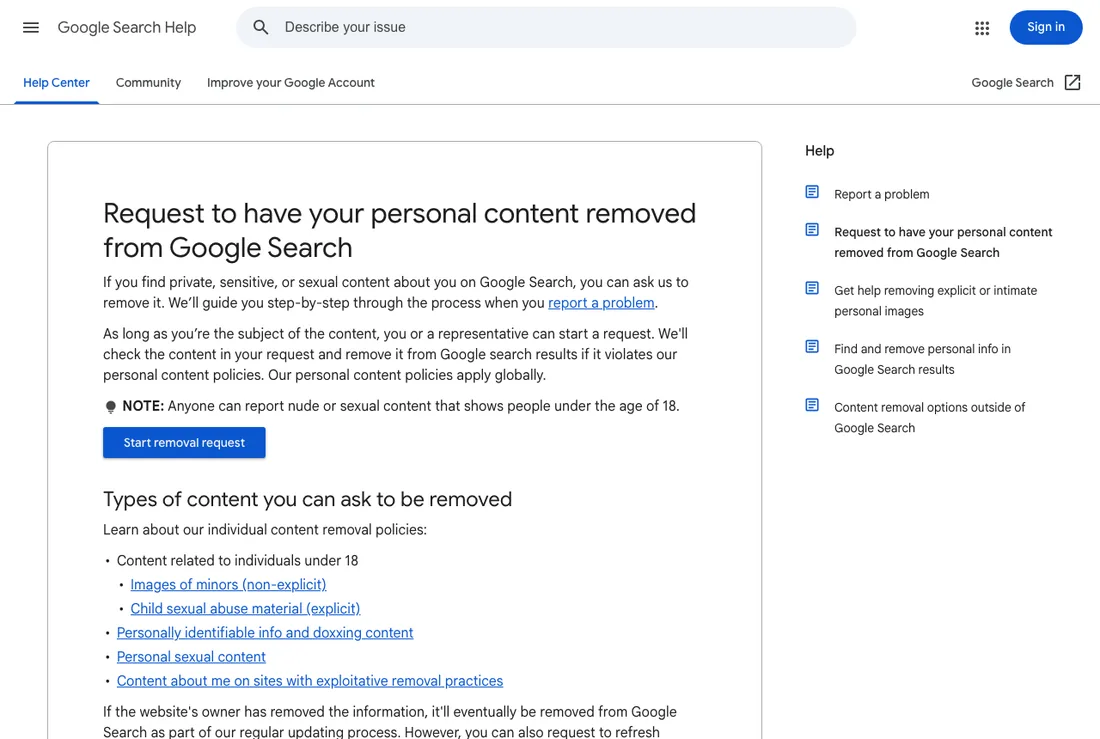
Google's own removal troubleshooter. It asks what the content is before it asks anything else, because the category determines whether there is a form at all. Screenshot taken 19 August 2026.
Start at Google's content removal troubleshooter rather than at a general contact form. It routes you by content type, and the route determines which policy your request is judged against.
Three details make requests land more often.
- Give the exact URLs. Not the domain, not a search result page. One line per URL.
- Point at the specific information. "My home address appears in the third paragraph" is actionable. "This page is about me" is not.
- Say whether the page is still live. If the site already removed the content and Google is showing a stale result, that is a different tool and a faster outcome.
Expect a decision rather than a conversation. If a request is refused, the refusal usually means the content did not fall in a covered category, and resubmitting the same request unchanged does not change that.
When personal information appears inside a review
Reviews sit under a different policy from Search, which surprises people who file once and assume they have covered everything. A review that publishes your phone number, your home address, or a photograph of you is handled through Google's process for reporting an inappropriate review, not through the Search removal form. Filing in the wrong place produces a refusal that reads as a rejection on the merits when it is really a routing problem.
The same logic applies across surfaces. A knowledge panel, an image result, an autocomplete suggestion, and a Maps listing each have their own reporting path, and none of them inherits a decision made on another.
What removal from Google does not do
Removal from Google Search changes findability on one search engine. It does not:
- Delete the page, which stays live at its address
- Remove the page from Bing, DuckDuckGo, or any other index
- Clear the Internet Archive or other mirrors
- Stop the same information being republished by a different site
- Remove the underlying record, if the source is a public record
That is not a reason to skip it. For most people, Google is where the information is actually encountered, and delisting the page a stranger would have found is a genuine change in exposure. It is a reason to be precise about what you have bought yourself, and to keep working the source in parallel.
When there is no route to remove personal information from Google
Some material is lawful, accurate, published by someone with a right to publish it, and outside every category above. There is no form for that. The honest options are narrower: ask the publisher directly, and if the answer is no, work on what else ranks for your name. That is search suppression, and it is a slower and less certain instrument than removal, which is exactly why it is the last one on the list rather than the first.
Sorting your own case into removable, delistable, or neither is most of the work, and it is the first thing a reputation audit does.
Questions about how to remove personal information from google
How do I remove my personal information from the internet for free?
Ask the source site to take it down, opt out of the people search sites that carry it, and file a removal request with Google for the categories its policy covers. All three are free. The paid version of this work is speed and volume, not access.
What information will Google remove?
Contact details such as a home address, phone number or private email; government identification numbers; bank and card numbers; medical records; confidential login credentials; images of handwritten signatures; non consensual explicit imagery; and personal details posted to harass with an intent to harm.
Does removing a result from Google delete the page?
No. Google delists the URL, which stops it appearing in Google results. The page stays live at its address, can still be opened by anyone with the link, and may still appear in other search engines and in archives.
How long does a Google personal information removal take?
Google does not publish a fixed timeline. Requests are reviewed and you receive a decision by email. Requests that name exact URLs and identify the specific information tend to resolve with fewer rounds than requests that describe a page in general terms.
What if the site puts the information back up?
A delisting applies to a URL. If the content reappears at a new address, that is a new URL and needs a new request. This is one of the reasons source removal is worth pursuing even when the Google request has already succeeded.