
How does Google decide what to show about you?
Google decides what to show by matching a query to pages it has already indexed, then ordering them by how well each page answers that query and how much corroboration it has from the rest of the web. On a name search the ordering usually comes down to three things: which pages are unambiguously about that specific person or business, which sites carry the most independent authority, and what people who ran the same search went on to click. Nothing in that process weighs whether a result is fair. This page explains the mechanism and why old pages persist.
Query intent comes first
Before anything is ranked, Google classifies what the query is for. The same words produce different result types depending on whether people asking them want a definition, a place, a purchase, a login, or an opinion.
For a person's name the classification is usually informational with a strong entity flavour: Google decides which entity the name refers to, then assembles a picture of it. This is why searching a common name gives a jumble, and searching an unusual one gives a coherent set of pages about one person. It also explains a frequent frustration, where results about a different person with your name will not shift. Google is not confused about you. It has decided the query is ambiguous and is serving both.
How Google ranks results once it knows the intent
The public description of the system has been consistent for years, and it maps onto four questions.
- Does this page match the meaning of the query? Not the keywords, the meaning. Google's language systems handle synonyms and paraphrase.
- Is the content useful and reasonably original? Thin pages that restate what is already ranked have little reason to appear.
- Is the source credible? Corroboration from independent sites is the strongest signal available.
- Is the page usable? Loads properly, works on a phone, secure connection, not buried in interstitials.
Ranking is comparative. A page does not pass a threshold, it beats the alternatives. This is the most important thing to understand about changing what shows for your name, because it means the goal is never to make one page good enough. It is to give Google something better than the page currently in that slot.
Authority signals and why a small site loses
Authority is earned by other sites, not declared by yours. Links from independent, established sources, consistent references to the same entity, and being cited by publications with their own standing all feed it.
That asymmetry is why a personal website usually loses to a news article about you. The newspaper's authority is decades old and site wide. Your site is new and narrow. Publishing a page saying the true version of events does not outrank the article, because nothing about that page tells Google other people find it credible. What does move is placement on sites that already carry authority: a professional association profile, an industry publication, a properly structured business listing, coverage that is genuinely newsworthy.
E-E-A-T is not a score
E-E-A-T stands for experience, expertise, authoritativeness, and trust. It comes from Google's guidelines for the human raters who evaluate search quality, and it is a framework those raters apply when judging whether results are good.
It is not a number attached to your site, and no tool measures it, whatever a dashboard claims. Its practical value is as a checklist for content about consequential topics: is there a real named author with real credentials, is the claim sourced, is the publisher identifiable, is the page maintained. Pages that fail those questions do worse on topics where quality matters most, and a name search about a professional is one of them.
Freshness helps some queries and not others
Google applies recency where recency is what the query wants. Breaking news, prices, sports results, anything with a date implied in it.
A name query is usually not one of those. There is no reason for Google to prefer a page published last week about a person over one published four years ago, unless the newer page is better in the ways above. Publishing frequently, on its own, is not a lever on a name search. This is the single most common wasted effort in reputation work.
Why old content persists
Five reasons, and it is worth knowing which one you are facing.
- It is on a stronger site than anything competing with it. Most common by far.
- It matches the query more precisely. An article headlined with your full name is a tighter match than your homepage.
- It keeps getting clicked, which reinforces the position.
- It has accumulated links over years that a new page cannot replicate quickly.
- Nothing better exists. Google fills ten slots from what it has. If there are only three substantial pages about you, the fourth best thing gets a place it would not otherwise earn.
Number five is the one people underestimate, and it is also the most actionable, because supply is the part you can change.
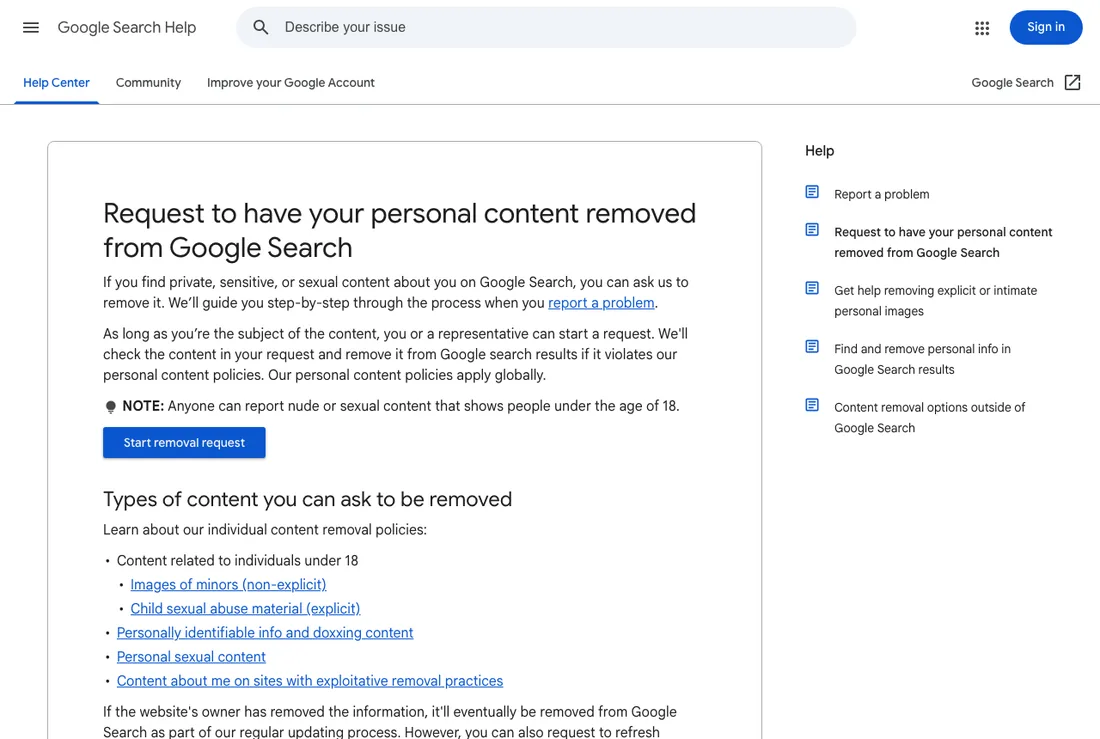
Google's own removal troubleshooter. It matters here because ranking is the wrong lever for anything the troubleshooter covers: where a result is genuinely removable under policy or law, that route is faster than any amount of optimisation. Screenshot taken 19 August 2026.
Where a result actually is removable, use the removal path rather than the ranking path. Google's content removal troubleshooter routes a request by content type and tells you honestly when the answer is to contact the site owner instead.
For a business, the result most often mistaken for a ranking problem is the review panel, which does not follow ordinary ranking at all. Reviews sit on their own policy track, and Google's process for reporting an inappropriate review is that track. Optimising a website has no effect on it.
It is also worth being clear about what the ranking systems are not doing. Nothing obliges Google to demote a lawful page because its subject objects, and the liability framework is part of why: platforms are generally not treated as the publisher of what others write. The Electronic Frontier Foundation's analysis of Section 230 sets out that framework. Fairness is not an input to the ranking systems, and a page that told you otherwise would be inventing a lever.
What this means if you want to change what shows
Work on supply and corroboration, in that order. Create or claim enough substantial, genuinely useful pages that clearly refer to you, on sites with their own authority, so Google has better options to fill the first page with. Make the entity unambiguous with consistent naming and structured data. Check separately whether any individual result has a removal route, because that route is faster than anything competitive.
Knowing which of your results is a supply problem, which is a removal case, and which is neither, is the first thing a reputation audit establishes.
Questions about how google decides what to show about you
How does Google decide what to show?
It classifies what the query is for, then ranks indexed pages on meaning match, usefulness, source credibility, and page usability. Ranking is comparative, so a page appears because it beats the alternatives rather than because it passed a threshold.
What is E-E-A-T?
Experience, expertise, authoritativeness, and trust: a framework from Google's search quality rater guidelines. It is not a score attached to a site and no tool measures it, though it is a useful checklist for content on consequential topics.
Why does an old article about me outrank my own website?
Usually because the publisher's site carries far more independent authority than yours and the headline matches the name query more precisely. Publishing more pages on your own site does not close that gap on its own.
Does publishing new content push old results down?
Only if the new content is genuinely better on the signals that matter and sits somewhere with authority. Freshness is applied where a query wants recency, and a name search generally does not.
Can Google remove a result because it is unfair?
No. Fairness is not an input to the ranking systems, and removal runs on published policy and specific legal claims rather than on the subject's objection. Checking whether a result has a removal route is a separate exercise from ranking.