
Active vs passive digital footprint: what is the difference?
An active digital footprint is the record you create on purpose: posts, comments, reviews, uploads, profiles, anything you typed and sent. A passive digital footprint is the record collected about you as a by-product of using the internet: cookies and tracking pixels, device and browser identifiers, location history, purchase data, and the profiles that data brokers assemble from all of it. The dividing line is intent. It matters because the two halves behave differently: the active half is mostly deletable at the source, while the passive half is mostly invisible to you, held by companies you have no account with, and reduced through opt-out requests rather than delete buttons.
Active digital footprint: deliberate sharing
Everything in the active half began with a decision. You wrote a post, left a review, uploaded a photograph, filled in a profile, answered a question on a forum, signed a public petition, or registered an account under your own name. You may have forgotten most of it. That does not make it passive. The test is whether a human choice put the data there.
The active half has three useful properties. It is findable, because you can retrace the accounts you have held. It is usually deletable at the source, because platforms give account holders a delete control. And it is attributable to you by name, which is why it tends to dominate what a search for your name returns.
It also has one property people underestimate. Deleting the original does not delete the copies. A post that was screenshotted, quoted, syndicated, or captured by a web archive carries on existing at addresses you do not control. That is not a reason to skip the cleanup. It is a reason to expect the cleanup to be partial and to plan around what stays.
Passive digital footprint: background collection
The passive half was assembled while you were doing something else. Loading a page sets cookies. Third-party scripts on that page report the visit to companies whose names you have never seen. Your browser and device announce a combination of settings specific enough to recognise you on a later visit. Apps report location. Loyalty programmes report purchases. Public records get scraped and republished. Data brokers buy, merge, and resell the result as a profile with your name attached.
You did not create any of that. You cannot see most of it directly. No setting inside your own accounts reaches it, because the parties holding it are not the parties you have accounts with. The Federal Trade Commission's consumer guidance on protecting your privacy online is a plain public starting point for what is collected in this half and what the available controls do about it.
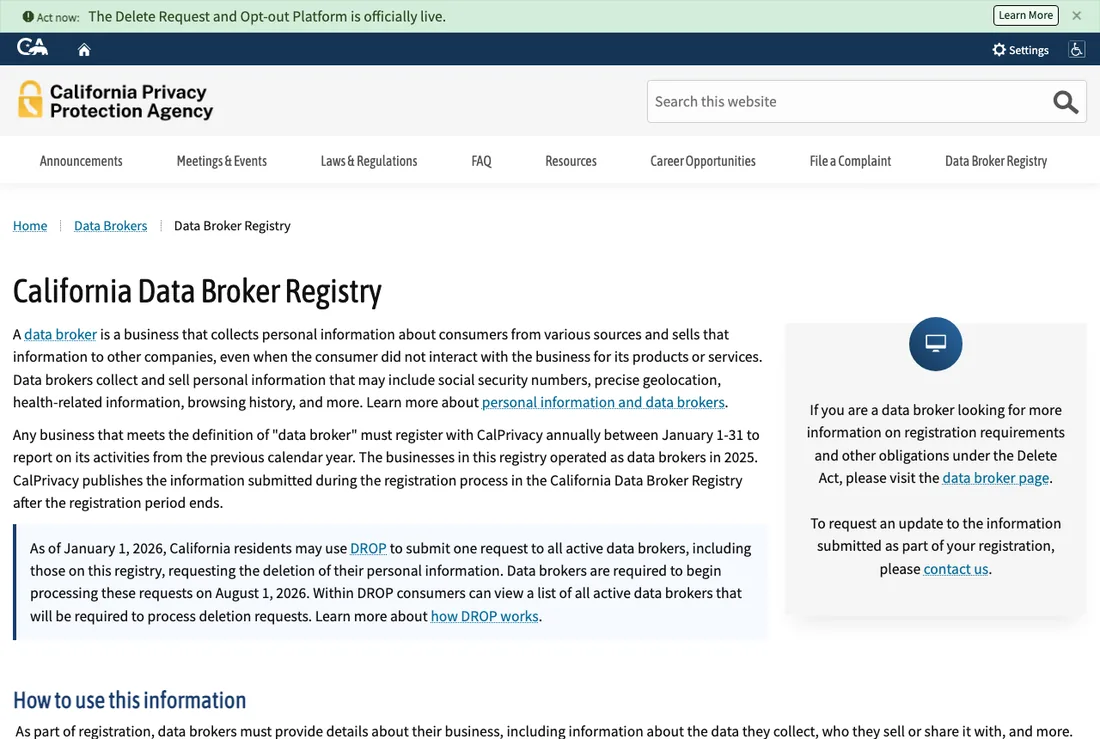
California requires data brokers to register with the state, and publishes the list. It is the clearest public evidence that the passive half of a footprint is a market with named participants rather than an abstraction. Screenshot taken 19 August 2026.
Tracking pixels and the parts you never see
A tracking pixel is a tiny image or script embedded in a page or an email whose only job is to report that you loaded it. In an email it reveals that the message was opened, roughly when, and often from where. On a web page it links your visit to an advertising profile that follows you across unrelated sites.
None of this is hidden in the legal sense. It is disclosed in privacy policies almost nobody reads, and increasingly in consent banners. It is hidden in the practical sense that the collection produces no visible artefact you could go and look at.
The difference, line by line
| Active footprint | Passive footprint | |
|---|---|---|
| Who created it | You, deliberately | Platforms, trackers, brokers |
| Can you see it | Yes, by retracing your accounts | Rarely, and never in full |
| Who holds it | Services you signed up for | Parties you have no relationship with |
| How it is reduced | Delete at the source | Opt-out requests, privacy settings, blocking |
| How fast it changes | Immediately, then copies linger | Slowly, and records often reappear |
| What it drives | Name search results | Ad targeting, profiling, background files |
Why the distinction changes what you can do
Sorting a problem into the right half is most of the diagnosis, because the two halves take different tools.
If the material is active, the route is deletion or correction at the source, then dealing with whatever copies exist. If the copy is on a site that will not act, and the content falls into a category Google's own rules cover, Google's legal removal request process is the separate route for asking the search engine rather than the site.
If the material is passive, deletion is the wrong frame entirely. You are asking a company that bought your data to stop selling it, and the mechanism is an opt-out or a state privacy request, not a delete key. Those requests work, and they also expire in practice: brokers refresh from the same public sources, so a record removed in spring can reappear by autumn under a different brand.
Where the two halves meet
The halves are not sealed off from each other. An address you typed into a shipping form is active at the moment you typed it and passive the moment it is sold onward. A photograph you posted publicly is active; the same photograph scraped into a face-matching index is passive. The most common way an active choice becomes a passive record is a signup: you gave a real name, email, and phone to a service, and that service shared or sold it.
This is also where the practical risk sits. Identity fraud generally uses the passive half, because that is where the contact details, addresses, and account history live. The FTC's guidance on identity theft sets out what to do if the compiled data is used against you, which is a different problem from an unflattering search result and is worth keeping separate in your head.
For most people the practical order is: audit the active half first, because it is visible and it is what other people actually read, then work the passive half as a maintenance habit rather than a project with an end. Which of the two is causing your specific problem is the first thing a reputation audit sorts out, and it is worth knowing before you spend a weekend on the wrong one.
Questions about active vs passive digital footprint
What is the difference between active and passive digital footprints?
Intent. An active footprint is what you deliberately created and sent, such as a post or a profile. A passive footprint is what was collected about you in the background, such as tracking data, location history, and broker profiles.
What is a passive digital footprint?
The record of you assembled without any deliberate act on your part: cookies and tracking pixels, device identifiers, location and purchase data, scraped public records, and the compiled profiles data brokers sell.
Is a passive digital footprint illegal?
Most of it is lawful and disclosed in privacy policies. Some categories are regulated, and several states now give residents a right to opt out of the sale of their personal information.
Which half should I deal with first?
The active half, usually. It is visible, it is what a name search returns, and you can act on it directly. The passive half is slower work and behaves like ongoing maintenance.