
What is business reputation management?
Business reputation management is the work of keeping what customers find about a business accurate, current and fair: the search results for its name, its listings, its review profile, and the way it handles complaints. For a small or mid-size business this is a narrower and more practical job than the corporate version. The audience is mostly local, the evidence is mostly reviews and search results, and the whole thing is visible on one screen. Most of it can be done in-house. This page sets out what to do first and what is realistically achievable.
What business reputation management covers
Four things sit inside that, in rough order of how much they matter to a business with a local or regional customer base.
- What the first page of results for the business name shows. This is the single highest-leverage surface, because almost every prospective customer and many prospective employees look at it.
- The review profile: volume, recency, rating and the visible response pattern.
- Listing accuracy across the map and directory services that feed those results.
- Complaint handling in public, which is read by people who will never complain themselves.
Everything else is secondary until those four are in reasonable shape.
Small business reputation is mostly local search reputation
For most businesses the reputation that affects revenue is not an abstraction. It is what appears when somebody searches the business name plus the town, and what appears in the map results for the service plus the town. Those two surfaces carry the reviews, the hours, the photographs and the questions, and they are where a decision usually gets made.
That has a useful implication. The work is measurable and largely free. Anyone can search their own business name from a logged-out browser and see what a customer sees, and doing that once a month catches most problems while they are small. The Bureau of Labor Statistics profile for public relations specialists describes the professional version of this work as writing, media relations and managing what an organisation publishes about itself, which is worth reading for a specific reason: none of the professional job description involves deleting other people's opinions, and any offer to do that should be treated carefully.
The review profile, and what actually moves it
Three variables carry almost all of the weight, and only one of them is about bad reviews.
| Variable | Why it matters | What moves it |
|---|---|---|
| Volume | A rating built on nine reviews is fragile. One on four hundred absorbs a bad week | Asking every customer, consistently, through a repeatable process |
| Recency | Customers discount old reviews heavily, and platforms surface recent ones | A steady request habit rather than an annual push |
| Response pattern | Read by prospects far more than by the reviewer | Replying to everything, briefly, including the positive ones |
The counter-intuitive part is that the fastest way to fix a poor average is almost never removal. It is volume. A business with a small number of reviews and one serious complaint has a rating problem that resolves itself once the sample grows, and how to get more Google reviews covers the mechanics of doing that without breaking any platform rules.
One thing to avoid: filtering who gets asked based on how happy they seem. Sending a review request only to customers who said something nice is review gating, it is against major platform policies, and it is treated as deceptive under consumer protection guidance.
What can and cannot be removed from a review profile
This is where most of the disappointment in this category lives, so it is worth being exact.
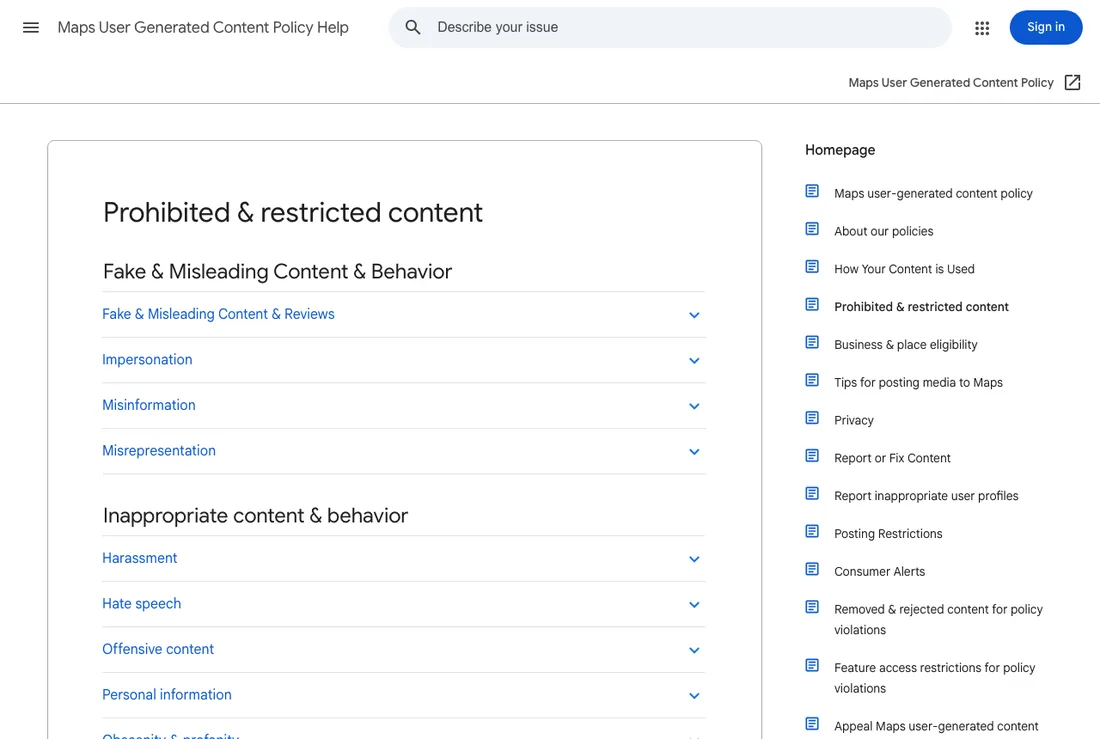
Google's prohibited and restricted content policy for Maps user-generated content. The categories on the left are the actual grounds for removal: fake and misleading content, impersonation, misinformation, misrepresentation, harassment, hate speech, offensive content, personal information. A review that is negative but genuine matches none of them. Screenshot taken 19 August 2026.
A review comes down when it violates a published policy. Reviews from people who were never customers, reviews that name and attack an employee, reviews containing personal information, reviews posted by a competitor, and reviews that are part of a coordinated attack all have a real route. A truthful negative account of a genuine experience does not, no matter how badly it reads or how much it cost.
The practical consequence is that the response is the product. A short, non-defensive reply that acknowledges the experience and offers a route to fix it is read by every future prospect, and it is the only part of a negative review a business fully controls. The detailed version is in how to respond to a negative review, and the removal routes that do exist are in how to report a fake Google review.
Referral impact: the part that does not show in analytics
Businesses with strong word-of-mouth systematically underestimate how much their online record matters, because the referral arrives by phone and looks like it came from a person. It usually did not arrive unchecked. A recommendation now routinely gets verified with a search before contact, which means the online record is filtering referrals that never register as lost leads.
There is no measurement for that, and inventing a number would be dishonest. What can be said is that the referred customer and the search customer see the same screen, and the referred one is the more valuable of the two.
Practical priorities for a first month
For a business starting from nothing, in order, with the highest-value items first.
- Search your own name, logged out, on a phone. Record what the first page shows. This is your baseline and it takes ten minutes.
- Claim and complete every listing you find, starting with the map profile. Hours, categories, services, photographs, and a description that matches how customers describe you.
- Fix inconsistencies in name, address and phone number across listings. This is dull, and it is the cheapest ranking work available.
- Set up a review request habit attached to a moment that already happens: the invoice, the completed job, the follow-up call.
- Reply to every existing review, oldest to newest, briefly.
- Report anything that clearly violates policy, and let the rest go.
- Write the two or three pages on your own site that answer the questions customers ask before buying, since your own site is the one result you fully control.
That list is roughly the free version of the service, and do-it-yourself reputation management covers where the free version stops working.
Preparing for the bad week
Small businesses experience reputational events too, and the difference is that there is no team. What substitutes for one is a small amount of preparation: who answers the phone if a journalist calls, what gets said in the first hour, who has the passwords to the listings and social accounts, and where the customer contact list lives if the main system is unavailable.
That is continuity planning at small scale, and Ready.gov's business continuity planning guidance is written for exactly this audience rather than for large enterprises.
The research on why the handling of an event matters as much as the event is summarised by the Institute for Public Relations on crisis management and communications. The part that transfers directly to a small business is that people judge the response, and the response is the half a small business fully controls.
When a business needs outside help
Honestly: when the problem is not reviews. A defamatory post from a named individual, a news article, a listing on a complaint aggregator, an old legal record, or a first page of results that a business cannot shift on its own are the cases where outside work earns its cost. Ordinary review volume and response habits are not, and a provider quoting a retainer for those is selling something a business can do itself.
Knowing which of those two situations a business is actually in takes about an hour of looking, and it is the first thing a reputation audit establishes.
Questions about business reputation management
What is business reputation management?
Keeping the publicly findable record of a business accurate and complete: its search results, its listings, its review profile on the platforms customers use, and how it handles complaints in public. For most small and mid-size businesses it is mostly local search and reviews.
Where should a small business start?
Search your own business name logged out on a phone and record what the first page shows. Then claim and complete every listing, fix name, address and phone inconsistencies, set up a repeatable review request habit, and reply to every existing review.
Can a business get a bad review removed?
Only if it violates the platform's published policy. Fake reviews, reviews from non-customers, personal attacks on staff, personal information and coordinated attacks have a real reporting route. A truthful negative account of a genuine experience does not.
How much does business reputation management cost?
The listings, review request habit and response work described here can be done in-house at no cash cost beyond time. Paid help earns its price when the problem is a news article, a defamatory post, a complaint aggregator listing, or a first page of results the business cannot shift.
Does responding to reviews actually matter?
The response is read by prospective customers far more often than by the reviewer. It is also the only part of a negative review a business controls, which makes it the highest-return few minutes available in this work.