
Can you delete your digital footprint?
You cannot delete your digital footprint completely, and anyone describing a clean slate is describing something that does not exist. What you can do is substantial: close accounts, delete posts at the source, submit data deletion requests where the law gives you one, and opt out of the brokers that republish your records. What survives that work is predictable rather than mysterious. Archived copies, cached pages, screenshots and quotations, syndicated republications, public records, and broker databases that refresh from the same sources all continue after the original is gone. Knowing which of those applies to your situation is the useful part.
What deletion actually removes
Deletion works at the source and nowhere else. When you delete a post, the platform removes it from its own systems and from the address where it lived. That is a genuine result and it is worth doing first, because the original is usually the copy that ranks.
What deletion does not do is reach outward. It does not touch a screenshot someone saved, a quotation in a news article, a syndicated copy on a partner site, an archived snapshot, or a database record that was licensed onward before you acted. None of that is a loophole. It is the ordinary consequence of a system where copying is free and instant.
Account deletion: the part that genuinely works
Closing an account is the highest-value action available to most people, and it is underused because it is boring. Work through the accounts you found in your audit and, for each one, export your data first, then delete rather than deactivate. Deactivation hides a profile; deletion asks the service to remove it.
Two cautions. First, some services impose a waiting period during which a login cancels the deletion, so avoid signing back in. Second, deleting an account does not always delete the content you posted with it. On several large platforms, comments and posts survive account closure in an orphaned or anonymised form, and removing them requires deleting the content itself before deleting the account. Check the order before you start.
Data deletion requests, and what they reach
Several state privacy laws now give residents a right to ask a business to delete personal information it holds about them, and a right to opt out of its sale. Those requests are real, they are free, and companies covered by the law have to answer them within a set period.
They also have defined limits. A business can generally keep information it needs to complete a transaction, comply with a legal obligation, or defend a legal claim. And the right reaches businesses covered by that state's law, which is not every company holding data about you. California's data broker registry is a useful working list precisely because it names companies that are on the hook for these requests, which makes it a better starting point than searching for opt-out pages one by one.
Archived copies and cached pages
Web archives take snapshots of pages and keep them at their own addresses. A page deleted today may still be readable in an archive taken last year. Some archives honour exclusion requests from the site owner; most do not act on requests from a third party who is merely mentioned on the page.
Search engine caches are a smaller and shorter-lived version of the same thing. A cached copy generally disappears as the engine recrawls and finds the page gone, which happens on its own timeline and can be pushed along with a removal request for outdated content.
Third-party republication
This is the category that defeats most cleanup plans. A single post can be quoted in a blog, aggregated by a scraper site, embedded in a forum thread, screenshotted into a social thread, and syndicated to a network of partner sites that all publish the same wire copy. Each copy has its own owner, its own contact form, and its own willingness to act, which ranges from cooperative to unreachable.
News is the hardest version. A story published by a newspaper and picked up by a syndication network exists in many places at once, and legitimate journalism is not removable on request. The realistic work with news is usually about what appears alongside it rather than about making it disappear.
The data broker refresh cycle
Broker records come back. Not because the opt-out failed, but because the broker rebuilds its database from the same public sources it used the first time: property records, voter files, court dockets, licence registers, and commercial data. Your opt-out removed a record; it did not remove you from the county deed index.
This is why footprint reduction behaves like maintenance rather than a project. Re-checking the brokers you opted out of two or three times a year is the difference between a result that holds and one that quietly reverses.
Autocomplete is not a copy, and does not delete like one
People often assume a search suggestion is stored content that can be deleted. It is not. Autocomplete predictions are generated from patterns in what people search for, and they change as those patterns change. Google's explanation of how Autocomplete predictions work sets out both the mechanism and the narrow policy grounds on which a prediction gets removed.
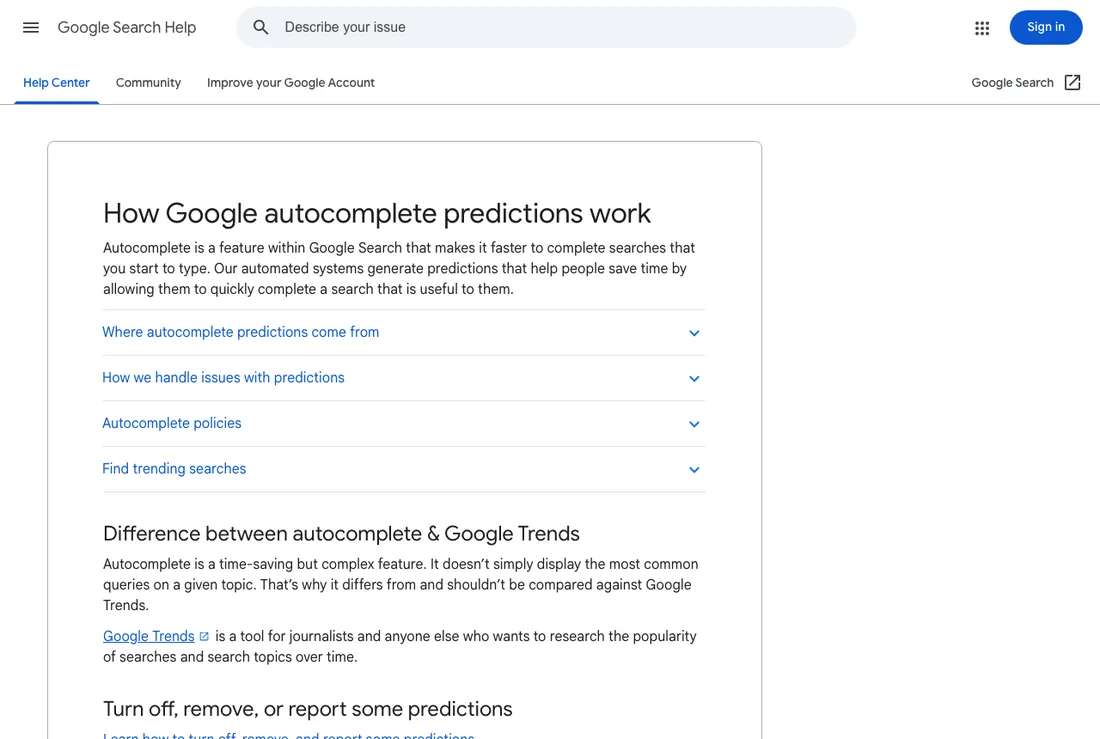
Google's own documentation on Autocomplete. Predictions are generated rather than stored, and removal happens on defined policy grounds rather than on request. Screenshot taken 19 August 2026.
What stays, listed plainly
| What you want gone | Deletable at source | What tends to survive |
|---|---|---|
| Your own post | Yes | Screenshots, quotes, archives |
| Your own account | Yes | Content posted with it, in some cases |
| People-search listing | Via opt-out | The broker record that regenerates it |
| Public record | No | Everything, it is a government record |
| News article | No | The article and its syndicated copies |
| Breach data | No | Copies already distributed |
| Search suggestion | Not applicable | Predictions change with search patterns |
What a realistic outcome looks like
The honest target is not an empty first page. It is a footprint where the accurate, current, self-published material is what a stranger finds first, where nothing sensitive is sitting exposed in a broker database, and where the items that cannot be removed are outnumbered rather than pretended away.
There is also a security dimension worth separating from the reputation one. If personal data is being used against you rather than merely being visible, the FTC's guidance on identity theft is the correct first stop, and it is a faster route than any deletion campaign.
Working out which items in your list are genuinely removable, which are reducible, and which are permanent is the whole job. It is also the first thing a reputation audit sets out, before anyone talks about doing work.
Questions about can you delete your digital footprint?
How do you remove your digital footprint?
You reduce it rather than remove it. Delete posts and close accounts at the source, submit data deletion and opt-out requests where the law provides them, and repeat the broker step periodically because records regenerate.
Can you delete something from the internet?
You can delete the original. Copies made before deletion, including screenshots, quotations, syndicated versions, and web archive snapshots, continue to exist at addresses the original owner does not control.
Do data deletion requests actually work?
Yes, within limits. Businesses covered by a state privacy law must respond, but they may keep information needed for transactions, legal obligations, or claims, and the law only reaches covered businesses.
Why did my people-search listing come back?
Because the broker behind it rebuilt the record from public sources such as property and voter files. The opt-out removed a listing, not the underlying public data, so re-checking periodically is part of the work.
Can a company delete my digital footprint for me?
A firm can do the same work faster and more systematically than you can, and it faces the same limits you do. Any offer to erase everything permanently is describing an outcome the mechanics do not allow.