What is reputation risk management?
Reputation risk management is the governance layer around reputational risk: recording each risk in a register with a named owner, setting the monitoring that would detect it, writing the thresholds at which it escalates, deciding what gets reported upward and how often, and reviewing whether any of that worked. It is administration rather than communication, and that is the point. Knowing a risk exists changes nothing on its own. What changes outcomes is a named person, a defined trigger, and a standing place on an agenda where the question gets asked again.
What reputation risk management adds to knowing the risk
Every organisation can list its reputational exposures. Very few can say who owns each one, what would have to be observed for it to escalate, and who would hear about it within an hour. Reputation risk management is the difference between those two states, and the whole value sits in the second column.
The failure mode it exists to prevent is specific and common: the organisation knew. Somebody logged the supplier finding, somebody read the exit interviews, somebody flagged the marketing claim. The information existed and never reached a person whose job included deciding about it. That is a governance failure rather than an intelligence failure, and no amount of monitoring software fixes it.
The risk framework it borrows from
Reputation risk management does not have its own methodology and does not need one. It uses the general risk process: establish scope and criteria, identify risks, analyse them, evaluate them against a stated appetite, treat them, and monitor and review throughout. ISO 31000, the international risk management standard, sets out that structure as guidance rather than as a certifiable requirement, which suits a risk category that resists precise measurement.
Appetite is where most reputation risk work either becomes real or stays decorative. An organisation that has never written down what it will not do has no basis for a fast decision when the opportunity to do it arrives with a deadline attached.
Governance: the register and the columns that work
A reputation risk register looks like any other register. The columns below are the ones that change behaviour; anything else is optional.
| Column | What belongs in it | Why it matters |
|---|---|---|
| Risk statement | Event, group who learns of it, conclusion they draw, action they take | Forces the causal chain instead of a mood |
| Owner | One named person, not a department | A shared owner is an unowned risk |
| Inherent score | Likelihood and impact before controls | Shows what the controls are carrying |
| Controls | What currently detects or prevents it | Reveals risks with no detection at all |
| Residual score | Likelihood and impact after controls | The number that should drive attention |
| Escalation trigger | The observable event that starts the response | Removes the judgment call at three in the morning |
| Review date | When it is looked at again | Stops a register becoming an archive |
The most useful moment in building one is the controls column, because it surfaces the risks nobody is watching. A high-impact exposure with the control listed as "management awareness" is an exposure with no control.
Monitoring controls that detect something
Monitoring in this context means three separate things, and organisations tend to buy the third and skip the first two.
- Internal reporting routes. A path by which frontline staff, human resources and procurement can raise a concern to someone who acts, without going through the person the concern is about.
- Operational indicators already collected. Complaint themes, turnover by team, audit findings closed without remediation, repeat safety events. This data usually exists and is never read as reputational signal.
- External listening. Reviews, search results for the organisation and its executives, forums, employee-review sites, trade press, and increasingly what AI answer systems say when asked about the organisation.
External listening is the visible layer and the least predictive. By the time something appears there, the conclusion has usually already been drawn somewhere internal.
Escalation thresholds
A threshold has to be observable by whoever is on duty. Write triggers, not adjectives.
- Any complaint alleging injury or discrimination, regardless of channel.
- Any regulator contact, including an informal one.
- Any journalist enquiry naming an individual or an incident.
- Any confirmed unauthorised access to personal data.
- Any supplier audit finding in a defined severity band.
- Any single piece of public content about the organisation crossing a defined reach threshold.
Each trigger needs a named recipient, a time limit, and an explicit statement that raising it is not a judgment about whether it matters. Thresholds fail most often because staff are unsure whether escalating a false alarm counts against them.
Where compliance and reputational risk overlap
Some reputational risks convert into legal exposure on a fixed date, and a register that tracks only the reputational half misses the conversion.
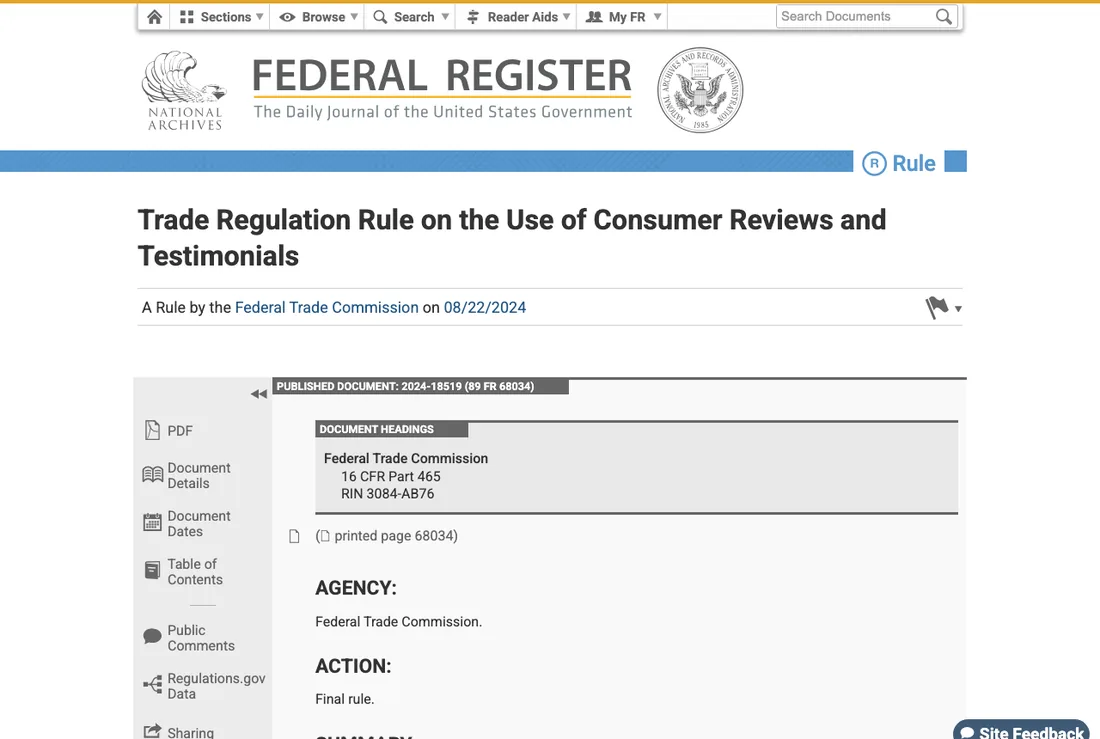
The rule as published in the Federal Register on 22 August 2024, at 16 CFR Part 465. Practices around consumer reviews that had previously been argued about as a reputational and ethical question acquired a specific regulatory text, which is exactly why regulatory change belongs in a reputation risk register as a live entry rather than as background. Screenshot taken 19 August 2026.
The broader body of the FTC's advertising and marketing guidance for businesses is worth a standing review line for any organisation whose growth depends on claims, endorsements, or user reviews. Nothing here is legal advice, and how a specific practice sits under a specific rule is a question for counsel.
Board reporting
Reporting upward fails in two directions. Too little, and the board learns about the exposure from the news. Too much, and reputational risk becomes a monthly slide of sentiment charts that nobody can act on.
The version that survives contact with a real board is short: the small number of residual risks above appetite, what changed since last time, which escalation triggers fired and what happened, and any risk where the control is currently absent. Sentiment metrics belong as supporting material rather than as the headline, because a board cannot act on a score with no named behaviour behind it.
Two adjacent frameworks are useful reference points for how oversight of this kind is structured elsewhere. The NIST Cybersecurity Framework puts governance alongside identification, protection, detection, response and recovery, which is a reminder that the oversight function belongs inside the framework rather than wrapped around it.
The operational half of the picture is worth reporting beside the reputational one, since a board asking about an exposure will usually ask what happens if it materialises. Ready.gov's business continuity planning guidance covers that side: which functions are time-sensitive, and what recovery is supposed to look like.
What a framework does not do
It does not prevent the underlying failures. It does not make an accurate account of a real event go away. It does not create judgment in people who do not have it, and a register maintained as a compliance artefact will produce nothing except a maintained register.
What it does is shorten the distance between somebody noticing and somebody deciding, which is where most of the avoidable damage in reputational events actually lives. If the immediate question is what is already published rather than what might be, a reputation audit answers that one first.
Questions about reputation risk management
What is reputation risk management?
The governance around reputational risk: a register with named owners, monitoring controls, written escalation thresholds, a stated risk appetite, and regular reporting upward. It is administration rather than communication, and that is what makes it work.
Who owns reputational risk?
Each specific risk needs one named individual, usually the executive who owns the underlying activity rather than the communications lead. Overall oversight typically sits with the board or its risk committee, because appetite is a governance decision.
What goes in a reputation risk register?
A risk statement written as a causal chain, one named owner, inherent and residual scores, the controls that currently detect or prevent it, an observable escalation trigger, and a review date.
How is reputation risk management different from crisis management?
Reputation risk management runs continuously and is about registering, owning and monitoring exposures. Crisis management is what happens when one of them materialises. A good register makes crisis activation faster because the trigger and the owner are already written down.