
What do reputation management services include?
Reputation management services break into six or seven real lines: monitoring what gets published about you, auditing and baselining what is there today, filing removal requests where a published route exists, suppression through material you own and control, review management, listing accuracy, and reporting. Providers package and rename these constantly, but a proposal maps onto them once you know the list. Which lines you need depends entirely on your items. A business with one policy violating review needs one of them. An individual with an old article and nothing else indexed under their name needs several.
What reputation management services cover, line by line
Providers describe their work in very different vocabulary, but underneath the packaging there are only six or seven real service lines. Reading a proposal is easier once you can map its language onto them.
| Service line | What it actually does | How you can tell it happened |
|---|---|---|
| Monitoring | Watches search, review sites, social and news for your name | A dated log of mentions, and alerts you actually receive |
| Baseline and audit | Records what appears today, item by item | A dated inventory with a route assigned to each item |
| Removal filing | Submits policy, privacy or legal requests where a route exists | The platform's own confirmation or refusal message |
| Suppression | Publishes and strengthens material you control | Live URLs you own, and position changes over time |
| Review management | Requests, routes, responds to and reports reviews | Response timestamps and a rating trend you can verify |
| Listing accuracy | Corrects business details and profile data across platforms | The corrected listings themselves |
| Reporting | Turns all of the above into something readable | A report with the underlying data attached |
Not every engagement needs every line. A business with one policy violating review needs one of them. An individual with an old news article and nothing else indexed under their name needs three or four.
Monitoring service: what it watches and what it misses
A monitoring service is a standing watch. It queries search engines, review platforms, social networks and news sources on a schedule and tells you when something new appears about your name or brand.
What it misses is worth knowing before you pay for it. Closed groups, private forums and messaging apps are invisible to it. Material behind a login is generally invisible. Content that never names you in a searchable way, such as a photograph with no caption, will not surface. And monitoring is not prevention: it tells you something exists, faster than you would otherwise have found out.
The output that matters is the alert reaching a person who will act on it. Monitoring that lands in an unread inbox is a line item, not a service.
Removal service: filing where a route exists
This is the line most buyers actually want, and it is the most misunderstood. A removal filing is a request submitted through a published channel: a platform's policy complaint form, a search engine's legal or personal information removal request, a copyright notice, or a data broker's opt out. The provider prepares the argument, files it, tracks it, and escalates or appeals when it is refused.
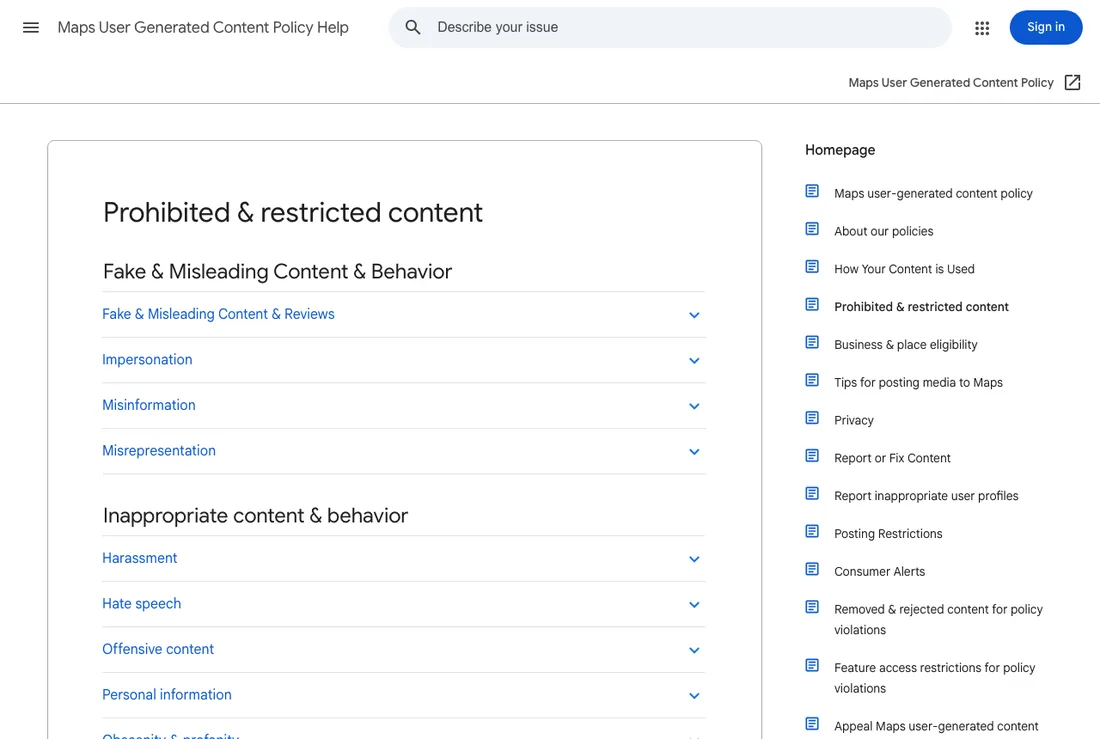
Google's own prohibited and restricted content policy for Maps reviews. These categories are the entire basis on which a review can be reported. A complaint that does not map onto one of them has nothing to succeed against. Screenshot taken 19 August 2026.
What you are buying here is argument quality and follow through, not access. The forms are public and you can file on them yourself, which our page on doing this yourself covers in detail. What a provider adds is knowing which policy category a given item fits, how to evidence it, and what to do with a refusal. A provider who declines to tell you which items you could file for free is not offering a service, and that pattern sits alongside others in the FTC's advertising and marketing guidance for businesses, which treats material omissions as a form of deception.
Suppression service: publishing to occupy the space
When content is lawful, accurate and staying put, the only remaining lever is what else appears alongside it. Suppression means building and strengthening material you control so it earns the positions the unwanted result currently holds.
In practice that is a publishing programme: owned pages, profiles on platforms that rank, professional directories, interviews and contributed articles, and the ordinary technical work of making all of it findable. It is slow, it is measured in months, and it is the line item that most often turns into an open ended retainer. The mechanics are on our page about search suppression.
Review management service, and where it crosses a line
Review management covers requesting reviews from real customers, routing them, drafting responses, reporting policy violations, and tracking the rating over time. Done properly it is the most reliably effective line in the list, because it works with arithmetic rather than against a platform's judgement.
It is also the line with a compliance edge. Requests must go to every customer rather than only the happy ones, incentives cannot be conditioned on leaving a positive review, and anyone connected to the business who writes one has to disclose that connection. The FTC's endorsement guides set out the disclosure expectations, and our page on review gating explains the filtering practice that crosses the line most often.
Reporting, and what a useful report contains
A useful report is boring and checkable: what was filed, what came back, which URLs moved and from what position, which reviews arrived, and what is queued next. It carries the raw data behind each claim, and a baseline date so you can see change rather than a snapshot.
A report that shows sentiment as a single score with no method behind it, or activity counts with no outcomes, is telling you the provider was busy. That is not the same as telling you something changed.
Service scope: what is included, and what is not in scope anywhere
Before comparing providers, write your own scope: the items, the outcome you want for each, the reporting you expect, and the term. Send the same document to everyone. The SBA's guidance on managing a business makes the general point that a system only works when a named person owns it, and reputation work is no different: somebody on your side has to own the scope, or the provider will own it for you.
Some things are outside the scope of any provider, and it is worth setting that expectation now. A truthful negative review that breaks no platform rule is not a removal candidate. Lawful reporting by a real news organisation generally stays. Public court records remain public. Nobody can promise a specific ranking position, because nobody controls the ranking. Which of your items fall inside a real service line and which do not is exactly what a reputation audit is for, and it is cheaper to find out before the contract than after it.
Questions about what reputation management services actually include
What services does reputation management include?
Monitoring, an audit and baseline, removal filing where a published route exists, suppression through material you control, review management, listing accuracy, and reporting. Most engagements use some of those lines rather than all of them, and the scope of work is what decides which.
What does a reputation management company do?
It watches what is published about a client, argues policy or legal cases to have specific items removed or corrected, builds and strengthens accurate material to occupy the space that clears, manages the review programme, and reports the whole thing against a dated baseline.
Which of these could I do myself?
Most of the filing. Platform complaint forms, search engine removal requests and data broker opt outs are public and free to use. What a provider adds is knowing which policy category an item fits, how to evidence it, and what to do when a request is refused.
Is removal or suppression the better service?
They are not alternatives, they answer different situations. Removal applies when a published rule or a specific law reaches the content. Suppression is what remains when the content is lawful, accurate and staying put. An audit tells you which of your items is which.
What should a monthly report contain?
What was filed and what came back, which URLs moved and from which position, which reviews arrived and how they were handled, what is queued next, and the raw data behind each of those claims against a dated baseline.